
yogabook / functional exercises / plantar flexion-focused walking
Feedback: We’d love to hear what you think of this description; please send us your feedback at:
postmeister@yogabuch.de
Last updated: 23 July 2026
Name: __
Common name: plantar flexion-oriented walking
Level: A
- Classification
- Contraindication
- Effects
- Preparation
- Follow-up
- derived asanas
- similar asanas
- Diagnostics
- Instructions
- Details
- Variants
Contents
Classification
classical: Functional exercise
psychomental: __
physiological: __
Contraindication
Effects
(852) Strengthening the plantar flexors
The plantar flexors are the key muscles involved in this walking style. Once the forefoot has made contact with the ground, they create an arched movement of the ankle joint around the balls of the feet, which propels the body forward by a corresponding distance in accordance with the angular functions. Each time this happens, the plantar flexors of one leg lift the entire body.
(862) Strengthening the supinators of the ankle joint
The supinators are involved in stabilising the ankle joint; furthermore, the supinating and plantarflexing tibialis posterior in particular to propulsion, making this a good exercise for this muscle, which is often not strong enough.
(867) Strengthening the tibialis posterior
The supinating and plantar-flexing tibialis posterior helps with propulsion, making this a good workout for this muscle, which is often not strong enough.
(872 )Strengthening the pronators des Ankle
Just like the supinators, the pronators must stabilise the ankle joint ; however, these also include the fibularis longus and the fibularis brevis, which also plantarflex, so that these muscles are effectively strengthened here.
Preparation
Follow-up
Derived asanas:
Similar asanas:
Diagnostics (No.)
(852), (862), (867), (872 ) Strength of the plantar flexors, The supinator und Pronators of the ankle joint
If the heel cannot be lifted very far off the ground, this usually indicates weakness in the plantar flexors, as they are responsible for this movement. Gait patterns vary considerably from person to person; some people can even be recognised by their gait. This may also reflect weakness in the muscles involved or pain-related issues. This exercise demands a fair amount of muscle strength and strength endurance from the plantar flexors, as the plantar flexors of one leg must lift the body repeatedly without momentum. Due to the speed of execution and the high repetition rate, the soleus – with its higher proportion of type 1 fibres – will be significantly more important here than the gastrocnemius. The muscles belonging to the flexor system of the ankle joint – the tibialis posterior (medial, acting as supinator) and fibularis longus and the fibularis brevis (lateral as pronators) plantar flexors are also involved and are likewise strengthened, although they contribute less to the work required than the triceps surae. In principle, it should be possible to lift the heel very clearly off the ground. If there is any doubt as to whether the result is sufficient, the unloaded active and passiverange of motion should also be assessed.
In a healthy musculoskeletal system, vigorous plantar flexion generated by the force of the triceps surae always produces a supinating moment at the sublatar joint. If this is absent, the Single Hell Rise Test should be performed as a supplementary test. If the result is abnormal, a pronounced and non-reducible flat foot should be assumed. It can be considered highly unlikely that the force of pronation and plantar flexion is sufficient to cause this effect.
If the observed supination is particularly pronounced, it should be checked whether the pronators long fibular muscle and short fibular muscle are sufficiently strong and can be activated.
If pronation occurs instead of the expected supination, a flat foot is likely.
(852) Disorders of the metacarpophalangeal joints
Painful disorders of the metatarsophalangeal joints most commonly manifest as hallux, in the form of hallux valgus, hallux rigidus or hallux limitus. The first two conditions are usually progressive and tend to involve painful, inflammatory phases. Furthermore, metatarsalgia may also occur independently of these conditions, for example due to a Morton’s neuroma. These conditions are usually the result of spread-out feet, as is hallux valgus.
(913) Tendency to experience cramps in the sole of the foot
Due to the high mechanical stress placed on the foot, its passive (particularly the plantar fascia and ligamentum plantare longum) or active tension system (longitudinally oriented intrinsic foot muscles) may also exhibit symptoms of overuse; in the former case, this would manifest as the symptoms of plantar fasciitis, whilst in the latter, it would primarily involve a tendency for the intrinsic foot muscles to cramp.
(924) Pathology associated with plantar flexion
The main condition that impedes plantar flexion is dorsal ankle joint impingement, of which there are several forms, such as that caused by an os trigonum.
Variants:
Instructions
- Choose a flat stretch of road for this walking exercise. If you want to increase the intensity after you’ve had a bit of practice, choose a hill.
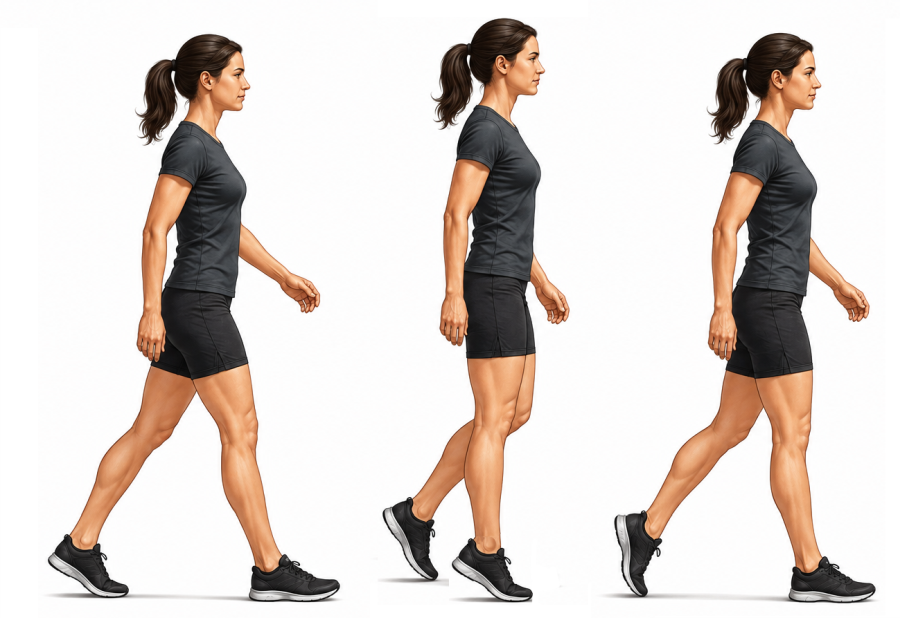
- Take small steps. Each step should be no more than about one to one and a half foot lengths. With each step, push your body upwards using the strength of the triceps surae by performing a powerful, but not explosive, plantar flexion at the ankle joint. Avoid shifting your centre of gravity significantly forwards, as this would make plantar flexion easier, because it would be completed whilst the other foot is already in contact with the ground. The aim is therefore to achieve a centre of gravity trajectory that oscillates as strongly as possible. The foot lands heel-first each time, and during the roll-off, it is primarily plantar flexion that propels the body forwards, as it moves the heel forwards in an arc around the balls of the feet that have already made contact with the ground. This also means that only minimal movements occur in the hip joint and knee joint. A voluntary pause whilst the body is raised as high as possible – i.e. at maximum plantar flexion – is not necessary, but may be incorporated.
Details
- Roll your foot so that it’s as close to the centre as possible. So use the control mechanism of the ankle joint to control the roll-off, rather than allowing the supinating moment and rolling off predominantly via the outer edge of the foot. In this way, the fibular muscle group is also strengthened as the lateral component of the braking system, particularly as the fibularis brevis and fibularis longus are also involved in plantar flexion. The biomechanically important tibialis posterior, as the medial component, is also activated by plantar flexion. However, the largest proportion, in percentage terms, of the force required to lift the body unilaterally with each step is generated by the triceps surae, meaning that this muscle group is subjected to a highly repetitive training stimulus, which is likely to have a strength-building effect whilst also promoting strength endurance. As the body is lifted unilaterally with each step, the Achilles tendon is also likely to benefit from this training.
- Make sure you don’t end up with a hollow back.
- In cases of metatarsalgia, Morton’s neuroma, hallux valgus or hallux rigidus, this exercise may only be possible to a limited extent, or may even be contraindicated.
- The exercise can be performed in your usual footwear, barefoot or in barefoot shoes. It is advisable to try out these options. Anyone who is not used to walking barefoot will notice that their feet are less resilient, which can lead to blisters forming relatively quickly. If blisters develop under the second and third metatarsophalangeal joints (MTP 2 and MTP 3), this is a good indication of spread foot.
- In cases of more advanced flat feet, the triceps surae may be affected due to the valgus position of the calcaneus and the associated displacement of the Achilles tendon relative to the axis of rotation of the subtalar joint, it can no longer generate a supinating torque there. These cases are also evident in an abnormal single heel rise test. This leads to a significantly altered balance of forces in the subtalar joint. If the tendon of the tibialis posterior is already elongated, then this muscle is functionally insufficient and a more or less pronounced valgus position of the calcaneus will be evident throughout. It is no longer possible to strengthen the tibialis posterior if the tendon is elongated. These cases should also demonstrate a significantly reduced strength for adduction of the foot during the exercise.
- As is well known, the position of the foot affects the joints further proximally, in this case particularly the knee joint. Make sure that the knees move in the sagittal plane and do not deviate medially or laterally.
- As with any walking pattern, our arms perform a counter-pendulum movement; however, due to the very limited stride length, walking speed and acceleration, this movement remains very moderate and should not be forced.
- Make sure you don’t lean your pelvis and body forwards, so that the respective
- the swinging leg does not make contact with the ground too early and begin the roll-off phase, which would result in a significantly reduced demand on the calf and foot muscles of the support leg.
- Of course, the technique described can also be applied to the Farmers’ Walk.