
yogabook / functional exercises / tibialis posterior training with a resistance band
Feedback: We’d love to hear what you think of this description – please send us your feedback at:
postmeister@yogabuch.de
Last updated: 12 February 2026
Common name: Common name: Posterior tibial muscle training with a resistance band
Level: A
- Classification
- Contraindication
- Effects
- Preparation
- Follow-up
- derived asanas
- similar asanas
- Diagnostics
- Instructions
- Details
- Variants
Contents
Classification
classical: functional exercise
physiological: strengthening of the tibialis posterior
Contraindication
Effects
- (862) Strengthening the tibialis posterior
Preparation
Follow-up
Derived asanas:
Similar asanas:
Diagnostics (No.)
Variants:
Instructions
- Sit on a chair or a weight bench.
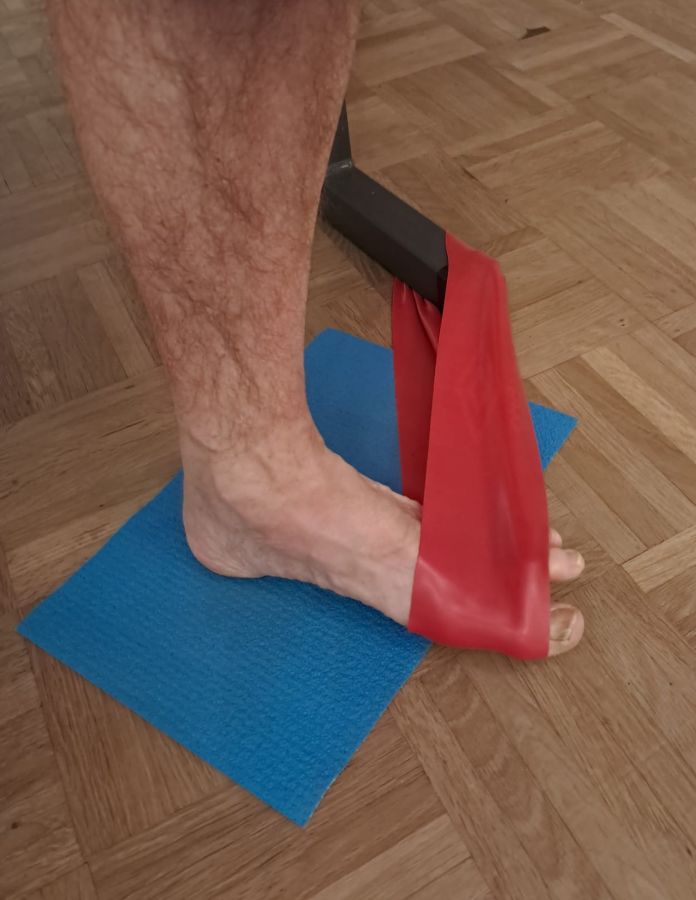
- To train your left tibialis posterior, wrap a resistance band around the front left leg of your chair.
- Pull the strap taut to the right and place the left big toe joint into the free end of the strap.
- Move your left heel further to the right than the metatarsophalangeal joint of your big toe.
- Now bring your left forefoot and midfoot together against the resistance of the band, and hold the tension for as long as possible.
- If the sensation of resistance is too weak, move your foot further to the right.
Details
- This exercise can be performed both isometrically and dynamically.
- This exercise makes use of the anatomical property of the subtalar joint, whereby supination is accompanied by adduction of the foot, just as pronation is inextricably linked to abduction. Although the tibialis posterior is also a plantar flexor of the overlying ankle joint, it is not possible with this movement to train it separately from the far more powerful triceps surae, comprising the soleus and gastrocnemius. This consideration makes it necessary to train the tibialis posterior in the second dimension of movement that it controls: supination. One exercise that utilises supination against the body’s gravity is the tibialis posterior strengthening exercise on the slant board. The exercise described here, on the other hand, does not primarily utilise supination, but rather the associated adduction and the fact that a pleasingly long lever arm is available when the force is applied at the metatarsophalangeal joint of the big toe. It is not advisable to apply the force directly to the big toe itself, particularly if there is already a deformity of the metatarsophalangeal joint in the form of hallux valgus, as the pull of the resistance band would further exacerbate the pathological deviation and could further overstretch the capsule and ligaments.
- Depending on the width of the strap, it is advisable to fold it in half so that, for the reason described above, no pressure is exerted on the big toes or on the fleshy inner part of the foot in the area of the longitudinal arch – which would reduce its effectiveness – but is instead directed as specifically as possible towards the metatarsophalangeal joint area.
- Ideally, the strap should run roughly perpendicular to the midline of the foot when in its furthest position.
- Unlike a weight or a cable machine – both of which are also frequently used as training aids – the resistance of the band increases in proportion to its stretch, which is very conducive to the exercise, as sufficient resistance can be achieved as soon as the heel is positioned correctly. A cable machine would also be suitable due to its physical properties, but it is likely to be difficult to attach to the metatarsophalangeal joint. However, this becomes possible if the foot is shod and the sole is stable.
- The left knee can be stabilised with the right hand, which is supported against the right leg.
- It is not entirely easy to achieve the movement solely through adduction of the foot; often, internal rotation of the lower leg at the knee joint is also involved. However, apart from cases of abnormal sensations in the knee joint, this is not a cause for concern, as it does not reduce the forces acting on the subtalar joint. In principle, this exercise can also lead to combined strengthening of the tibialis posterior and the internal rotators of the knee joint, i.e. the inner hamstring group, the gracilis and the sartorius, which makes sense if these are to be trained for the stabilisation of the knee joint anyway. As a general rule, however, in such combination exercises one muscle group tends to be weaker than the other, thereby limiting the extent to which the other can be strengthened.
- It is not uncommon for the heel to tend to slip laterally. In such cases, a friction aid, such as a patch, should be used under the heel.